

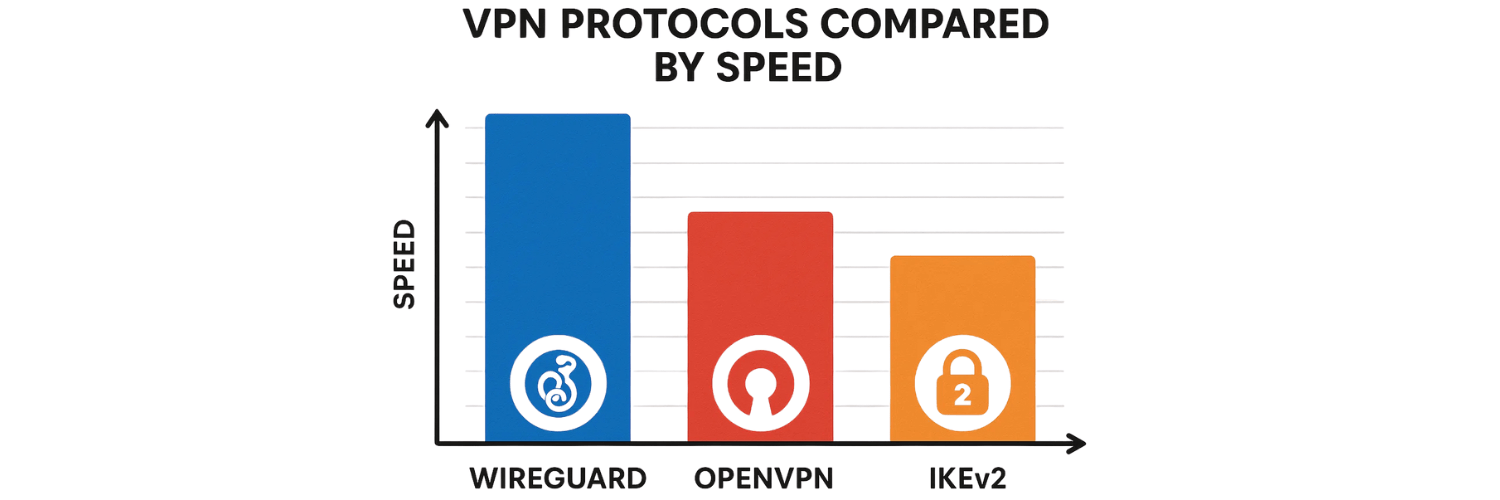
When choosing a VPN, speed is often just as important as security. The protocol your VPN uses plays a major role in determining how fast your connection will be. In 2025, the most commonly used VPN protocols are WireGuard, OpenVPN, and IKEv2/IPSec. Each has its strengths and weaknesses, from lightning-fast performance to rock-solid stability.
This guide compares these three protocols by speed, efficiency, and real-world performance so you can decide which is best for your streaming, gaming, or secure browsing needs.

1. WireGuard – The Fastest Modern Protocol
WireGuard is the newest VPN protocol to gain mainstream adoption, and in just a few years, it has become the gold standard for speed and efficiency. Unlike older protocols such as OpenVPN, which have hundreds of thousands of lines of code, WireGuard is built with only a few thousand. This makes it lighter, easier to audit for security flaws, and highly efficient in processing encrypted traffic.
Because of this streamlined design, WireGuard is much less resource-intensive. That means even on older laptops, smartphones, or low-power devices, it can run smoothly without draining CPU power or battery life. VPN providers around the world have embraced WireGuard, often making it their default protocol for users who want maximum speed without sacrificing privacy.
Speed Performance
Near-base speeds: In most tests, WireGuard maintains 90–95% of your original internet speed, making it the fastest mainstream protocol available.
Low latency: It’s ideal for online gaming, HD streaming, and video calls, where every millisecond counts.
Instant reconnections: If your network drops, WireGuard re-establishes the tunnel almost instantly. This makes it especially useful for mobile users who frequently switch between Wi-Fi and cellular data.
Pros
⚡ Extremely fast and efficient thanks to its lean codebase.
🔒 Modern encryption (ChaCha20, Poly1305) ensures strong security without slowing you down.
📱 Cross-device performance is excellent on mobile, Wi-Fi, and wired connections alike.
🔧 Easy to configure and optimize for VPN providers, meaning smoother service for users.
Cons
🆕 Still relatively new compared to OpenVPN, which has been tested for over 20 years. Some advanced features like obfuscation or stealth modes are not as widely available yet.
🔐 Privacy concerns: Early versions stored user IP addresses on the server until reboot. While most VPN providers have since implemented dynamic key management and other workarounds, it’s still a consideration.
Best For
WireGuard is best suited for users who want maximum speed combined with strong, modern security. It’s the top choice for:
Gamers who need low latency
Streamers who want smooth 4K playback
Remote workers who require stable video calls
Mobile users who switch networks often
2. OpenVPN – Reliable but Slower

OpenVPN has been the industry standard protocol for nearly two decades, and for good reason. It’s open-source, meaning its code is publicly available for security experts to audit. This transparency has made OpenVPN one of the most trusted and widely supported VPN protocols in the world. Virtually every VPN provider includes OpenVPN, ensuring broad compatibility across operating systems, routers, and third-party VPN clients.
OpenVPN uses SSL/TLS encryption, the same technology that secures HTTPS websites. While this makes it extremely secure, it also makes the protocol heavier and more resource-intensive compared to modern protocols like WireGuard. As a result, OpenVPN tends to be slower, especially on devices with limited processing power.
Speed Performance
📉 Typically results in a 15–25% reduction in speed compared to your base internet connection.
⚡ UDP mode: Optimized for speed. It’s faster than TCP and ideal for streaming, gaming, or VoIP calls where real-time performance is important.
🛡️ TCP mode: Prioritizes reliability over speed. It ensures data packets arrive in order, making it suitable for browsing, downloads, and secure connections on unstable networks.
Pros
🔒 Extremely secure and battle-tested with AES-256 encryption and robust key exchange methods.
🌍 Universal compatibility: Works on almost every device, platform, and VPN provider.
🔀 Flexible options: Users can choose between UDP (speed) or TCP (reliability) depending on their needs.
🛠️ Customizable: Supports advanced configurations, certificates, and third-party tools.
Cons
🐢 Slower performance compared to WireGuard and IKEv2, especially on long-distance connections.
💻 More CPU-intensive: The heavy encryption process can tax older or lower-powered devices.
⚙️ Complex setup: While most VPN providers make it easy, manual OpenVPN configuration can be difficult for beginners.
Best For
OpenVPN is ideal for users who:
Prioritize security and reliability over raw speed.
Want a universally supported protocol that works everywhere.
Use VPNs on routers, smart TVs, or legacy devices where newer protocols may not be available.
Need flexibility to switch between UDP and TCP depending on their network conditions.
3. IKEv2/IPSec – Fast and Mobile-Friendly

IKEv2 (Internet Key Exchange v2) combined with IPSec encryption is a VPN protocol that strikes an excellent balance between speed, stability, and mobile performance. While not as modern as WireGuard, it has earned a strong reputation for being lightweight and reliable, particularly on smartphones and tablets. One of its biggest advantages is seamless reconnection: when your device switches from Wi-Fi to mobile data (or between networks), IKEv2 re-establishes the VPN tunnel almost instantly. This makes it a favorite among travelers and commuters who frequently change networks.
Because IKEv2 is supported natively by major operating systems like iOS, Android, and Windows, it doesn’t require third-party installation. This built-in support means faster setup, reduced compatibility issues, and consistent performance. It’s also less CPU-intensive compared to OpenVPN, giving you smoother performance on mobile devices with limited resources.
Speed Performance
⚡ Faster than OpenVPN in most cases, though generally not as quick as WireGuard.
📺 Great for browsing, streaming, and light gaming, especially when using nearby servers.
📱 Excels on mobile devices, thanks to its ability to maintain stable connections during network switches.
🌐 Performance can dip slightly on restrictive networks where IKEv2 is blocked, requiring fallback to another protocol.
Pros
🚀 Fast and lightweight, providing strong speeds without draining system resources.
📱 Perfect for mobile devices and users who travel frequently.
🖥️ Built-in support on iOS, Android, and Windows (no need for extra apps).
🔒 Strong security when paired with IPSec encryption.
Cons
🐢 Not as fast as WireGuard, especially for high-bandwidth tasks like 4K streaming or large downloads.
🔐 Fewer advanced privacy features compared to OpenVPN (e.g., no double encryption or custom routing options).
🚫 Can be blocked by firewalls, especially on restrictive networks like corporate or government Wi-Fi.
Best For
IKEv2/IPSec is best suited for:
📱 Mobile users who frequently switch between Wi-Fi and cellular data.
✈️ Travelers and commuters who need reliable connections on the go.
🔧 Users who want simple, built-in VPN support without complicated setup.
Anyone who prioritizes stability and convenience over advanced customization.
VPN Speed Comparison Table (2025)
Protocol | Average Speed Drop | Latency | Best Use Case | Security Level |
WireGuard | 5–10% | Very Low | Gaming, streaming, all devices | High |
OpenVPN (UDP) | 15–25% | Medium | Secure browsing, global compatibility | Very High |
IKEv2/IPSec | 10–15% | Low | Mobile use, travel, quick reconnections | High |
Conclusion
When it comes to VPN speed in 2025:
WireGuard is the clear winner for most users, offering blazing-fast performance without sacrificing security.
OpenVPN remains the most reliable and compatible choice, especially for users who need maximum privacy.
IKEv2/IPSec is best for mobile users who value stability and seamless reconnections.
Ultimately, the “fastest” protocol depends on your specific use case. For gaming and streaming, WireGuard shines. For global security and censorship resistance, OpenVPN is the most dependable. And for mobile browsing, IKEv2 is the way to go.
FAQs
1. Which VPN protocol is the fastest?
WireGuard is currently the fastest VPN protocol, with minimal speed loss.
2. Is WireGuard more secure than OpenVPN?
Both are highly secure, but OpenVPN has been tested longer. WireGuard is considered safe for general use.
3. Should I use IKEv2 or WireGuard on mobile?
WireGuard is faster, but IKEv2 offers smoother reconnections when switching networks.
4. Why is OpenVPN slower than WireGuard?
OpenVPN uses heavier encryption processes and runs more background code, making it slower.
5. Can I change protocols in my VPN app?
Yes, most VPN apps let you switch between WireGuard, OpenVPN, and IKEv2 in the settings.
6. Is WireGuard good for streaming Netflix?
Yes, WireGuard is excellent for streaming as it maintains high speeds and low latency.
7. Does IKEv2 work on desktop computers?
Yes, but it is most commonly used on mobile devices due to its fast reconnections.
8. What’s better for gaming: OpenVPN or WireGuard?
WireGuard is better due to its lower latency and faster speeds.
9. Can governments block VPN protocols?
Yes, but WireGuard and OpenVPN (UDP) are harder to block compared to IKEv2.
10. Which protocol should beginners use?
WireGuard is the easiest and fastest option for most beginners.
Related links
VPN Speed Test: How to Measure and Understand Your VPN’s Performance
VPN Speed Fluctuations: Why Your VPN Is Fast One Day and Slow the Next
Why Is My VPN Slow? 7 Reasons and How to Fix Them
How to Speed Up Your VPN: Settings, Tools, and Tricks That Work
Fastest VPNs of 2025 (Tested & Ranked)
How VPN Speed Tests Work: Ping, Download, Upload, and Jitter Explained
Why VPNs Slow You Down: Encryption, Routing, and Server Load
VPN Speed vs Security Trade-Off: Finding the Sweet Spot
Tags

About VPNTest
Content Specialist with expertise in cybersecurity and online privacy. Sarah has been testing and reviewing VPN services for over 5 years and regularly contributes to leading tech publications.
View all articles by VPNTest →




Never Miss an Article
Subscribe to our newsletter to receive the latest VPN guides, security tips, and industry news directly in your inbox.